Relationships Between the Texture Synthesizer and MSG Processing

In yesterday’s post, we discussed how to use the Texture Synthesizer and keyframe interpolation in the PASeq timeline to create a simple self-animating color gradient mapped texture field animation. We also mentioned that you could build the same effect using MSG as opposed to the Texture Synthesizer (as shown above). We will show how to…
How Temporal Generators Work

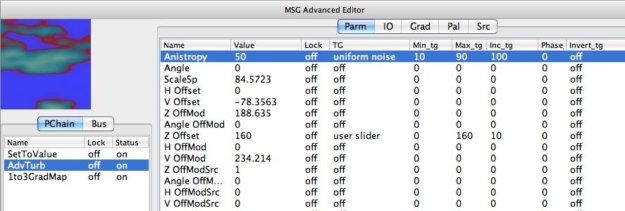
This post will discuss a simple approach you can take to help you get a better feel for visualizing how different temporal generators work.     The question was actually posted in a discussion about temporal image processing effects, so let’s start by making the distinction between the 2 clear. Temporal image processing effects are…

Source Colorizing an Existing MSG Preset : Part 2

In a post 2 days ago we showed how to modify a MSG effect so that it’s coloring was derived from a custom color palette generated from a specific source image. The effect’s custom coloring is built into the resulting modified MSG preset. So if the source image is later changed, the effect’s coloring continues…

Swap Evolving a Fixed MSG IO Routing Configuration

 Today’s post started with the MSG preset we hand built in yesterday’s post that generated an abstract image based on combining together 3 1C Truchet FlipMod processors and a 3C Truchet Mod1 CP processor to build up an overlaid abstract patterning image. I then worked with the Evolution Editor, using the Swap control button in…